
'Over the last two decades, the India-French relationship has grown steadily, no major political difference having darkened the sky between Paris and Delhi,' says Claude Arpi.

The success of Anil Ambani's ambitious defence plan will depend partly on whether he can persuade government officials and international partners that he can build sophisticated equipment and partly on whether the PM can get India's notoriously slow procurement process to work, say Paritosh Bansal, Sanjeev Miglani and Promit Mukherjee.

'The "Hollandisation" of British policy may not bring the expected gains as the future may show,' says Claude Arpi.

'China any day would prefer to team up with India and dump Pakistan once the resolution of the border dispute becomes an accomplished fact.'
Facing stiff challenge to see Janata Dal-United candidates through in the coming bypoll for two Rajya Sabha seats in Bihar, Nitish Kumar on Saturday appealed to arch rival Lalu Prasad, Congress and Communist Party of India to make common cause to "foil the game plan of BJP to destabilise the government".

Amid souring ties, the president visited Beijing for three days. On his return to India, a hope of better ties has arisen, says senior correspondent R Rajagopalan, who travelled with Pranab Mukherjee to the Asian superpower.

'We should build a military with the capability to fight today's war on priority -- balancing it with the requirements of the future,' says Lieutenant General Anil Chait, one of the Indian Army's most cerebral thinkers who recently retired as chief of the Integrated Defence Staff, in his agenda for the new defence minister.

Thailand expressed interest in the Indian defence industry and its experience and expertise in the field of defence R&D and production. Modi welcomed Thai investments in India in the potential areas under the 'Make in India' initiative, especially in the manufacturing sector, infrastructure development, tourism and hospitality facilities.

The developments in Af-Pak region, particularly the fall out of Pak political paralysis, would make President Xi Jinping's task a little more complicated, says Colonel R Hariharan.
Nawaz Sharif may have permitted the trial of Jaish-e-Mohammed terrorists for the Pathankot attack. But this fell apart because of General Raheel Shareef's keenness to make Kulbhushan Jadhav the centerpiece of global attention. Ambassador G Parthasarthy, a former Indian high commissioner to Pakistan, reveals the Pakistan army chief's gambit against India.
The calculated playing up of confidence by Amit Shah and his team obviously means that the BJP has a strong counter-strategy in place to turn the tables on the Congress before the monsoon session is over, reports Sheela Bhatt/Rediff.com.

India will be informing Sri Lanka about an official working with the Pakistan High Commission in Colombo who was allegedly playing a key role in planning terror strikes at the behest of ISI on the US and Israeli consulates in the southern part of this country.
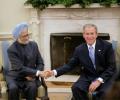
'The nuclear deal required Prime Minister Manmohan Singh to gamble the future of his government on a vision for the future of his nation.'

'The creation of Pakistan was integral to Britain's grand strategy.' 'If they were to ever leave India, Britain's military planners had made it clear that they needed to retain a foothold in the NWFP and Baluchistan because that would provide the means to retain control of Iran, Iraq, Kuwait, the UAE, Bahrain and Qatar.'
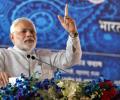

'A couple of hours before the H-Hour, the Kupwara division opened small arms and mortar fire on posts opposite its area of operation.' 'This was a diversionary tactic.' 'As Pakistani forces began to react to the firing, special forces teams began to slowly cross the LoC into PoK.' Nitin Gokhale reveals how planning for the surgical strikes began hours after the Uri attack.

'It is highly doubtful that the Trump administration will consider inserting itself into the volatile India-Pakistan dispute.'
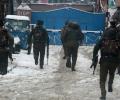
'We need to be in a perpetual state of aggression, and able to swiftly change the goal posts to keep Pakistan in a state of imbalance,' argues Sanjeev Nayyar.

'After a strategic pause though, Beijing will revive its policy of slowly creeping towards acquiring sovereignty over the South China Sea.'

The Turkmenistan event underscores the lengths to which China's oil-and-gas companies will go to curry favour in resource-rich locales.
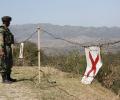
'The response to terror is not always reciprocal terror, nor is launching a conventional response the best response.' 'The best response is to make the sponsor pay a price he cannot afford,' says former RA&W chief Vikram Sood.

'We are witnessing a spectacle of breathtakingly creative diplomacy at work, riveted on the firm foundations of the country's strategic autonomy,' says Ambassador M K Bhadrakumar.

From early indications, the Modi government's foreign policy seems to be pragmatic and reciprocal, says K G Suresh.

'The ISI has given a stunning display of its capacity to do with impunity what it likes within Kabul. Incensed over the triumphalism of the hardliners in Kabul, the ISI has hit out; it is a typical ISI reflex action that Indians are familiar with,' says Ambassador M K Bhadrakumar.
At no other time has a single meeting of the leaders of two democracies been so critical and hazardous.

52 world leaders, including Narendra Modi, will attend this week's Nuclear Security Summit in Washington, DC. Obama will meet separately only with the Chinese president.

Describing the Narendra Modi-led BJP's electoral victory as a "breathtaking landslide", eminent American think tanks and experts have said the win has given him an opportunity to "redefine" Indian politics.
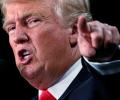
The US foreign and security policy establishment, says Ambassador M K Bhadrakumar, apprehends that Trump may compel them to exorcise the 'unipolar predicament', and bring foreign and security policies to reflect the desires and priorities of the American public.

The outcome of the Bangkok NSA-level talks underscores that Pakistan has got exactly what it wanted -- talks at different levels, talks on Kashmir, talks on mutual concerns regarding terrorism, talks on ceasefire on the border. What if any has been India's gains remains unexplained, says Ambassador M K Bhadrakumar.

'India is a huge market for Chinese goods. I don't think a war stands to logic when you have economic compulsions, but then Chinese are known to do illogical things.'

'The Mansoor Taliban is really an extension of the Haqqani Network which in turn is an instrument of the ISI. With Ashraf Ghani ready to dance to Pakistani tunes and with the Haqqani Network becoming part of the Afghan government, Pakistan is all set to see the fruition of its strategic policy,' says Sushant Sareen.

'It was a mission undertaken in darkness in every sense -- literally, because Afghanistan had no electricity at that time; and, metaphorically because Delhi historically dealt only with the Pashtuns of Afghanistan and the foreign ministry's vast archives had nothing to offer on the culture and politics of the northern tribes in the Hindu Kush.'
.jpg)
Both India and China have demonstrated levels of maturity in diffusing tensions and ensuring that the border remains by and large incident free, says Seema Mustafa

The man behind Aligarh Muslim University 200 years on.

With clouds of storm hovering over Parliament's budget session, President Pranab Mukherjee on Monday sought the "cooperation" of all MPs in the smooth conduct of legislative business but gave no indication of plans to bring changes in the controversial land acquisition ordinance.
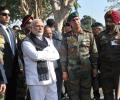
'The attack on the Pathankot base constituted an act of war. Yet Modi's only public comment up until now on that attack has been to blame it on "enemies of humanity".' 'Modi came to power talking tough about Pakistan. But in office, he has pursued a Pakistan policy that has lost both direction and purpose,' argues Brahma Chellaney.

Hamid Anasari's was not talking of reservation for the whole religious community to which he too happens to belong. Yet, sections of media chose to put words into his mouth and then subject him to the criticism he never deserved. This does not augur well for our media or democracy, says Mohammad Sajjad.

'The entire Ufa fiasco was predictable and predicted. The Ufa venue had created international interest in the initiative and its failure may have implications for both Pakistan and India. What remains for Modi to do is to produce a prettier rabbit out of his hat next time to deal with the Pakistan imbroglio,' says Ambassador T P Sreenivasan.

Can we make high speed 4G Internet available at 10 cents per GB, and make all voice calls free of cost -- that too in a large and diverse country like India? Can we make high-quality but simple breast cancer screening available to every woman, that too at the extremely affordable cost of $1 per scan? Can we make a portable, high-tech ECG machine which can provide reports immediately and that too at the cost of 8 cents a test? Can we make an eye imaging device that is portable, non-invasive and costs 3 times less that conventional devices? Can we make a robust test for mosquito-borne dengue, which can detect the disease on day 1, and that too at the cost of $2 per test? Amazingly, says Dr R A Mashelkar, the eminent scientist, all this has been achieved in India, not only by using technological innovation but also non-technological innovation.

'Pakistan's negativism should be seen as the reason for India losing interest in SAARC.'
